
Our Philosophy, in Practice
Our Philosophy of Healing names what we believe. Our model names how we live it — in how we show up with each person, how we design healing itself, and how change grows outward through community. Together, they explain what we believe, how we cultivate healing, and how we understand lasting change.
The Relational Care Model — How We Show Up.
We notice. We reach out. We ask gently. We listen. We adapt. We stay connected.
Care at MCW begins with how we show up for each person. Underneath all of it is attunement — responding to the person actually in front of us, not a predetermined plan.
We notice. We pay attention when someone seems overwhelmed, disconnected, or when life has become heavy.
We reach out. We don't wait for someone to struggle alone, or to have to ask for help.
We ask gently. We ask what support would actually feel helpful, rather than assuming.
We listen with humility. We honor lived experience, and let each person define what they need.
We respond with flexibility. We adapt to caregiving, work, transportation, financial, and other real-life realities.
We protect dignity. We offer support without judgment, shame, or requiring anyone to prove their need.
We build trust through consistency. Relationship isn't a one-time intervention — people know MCW will keep showing up.
The Majestic Healing Pathways™ Framework — How We Cultivate Healing
If the Relational Care Model is how we show up, the Majestic Healing Pathways™ Framework is how we design the healing itself — six pathways, in an intentional order, each one making the next possible.
1. Belonging & Psychological Safety — nothing else works until someone feels safe and knows they belong.
2. Mindful Movement & Embodied Awareness — reconnecting with the body, gently.
3. Breath & Nervous System Regulation — steadying the body's stress response.
4. Rest & Restoration — the often-missing piece that makes healing sustainable.
5. Connection & Community — where individual healing becomes shared.
6. Choice, Agency & Empowerment — the destination: moving from recipient of care to author of one's own healing.
The Framework guides how we design programs, build partnerships, prepare leaders, and create the environments where healing becomes increasingly possible.
The Community Healing Model — How Change Grows
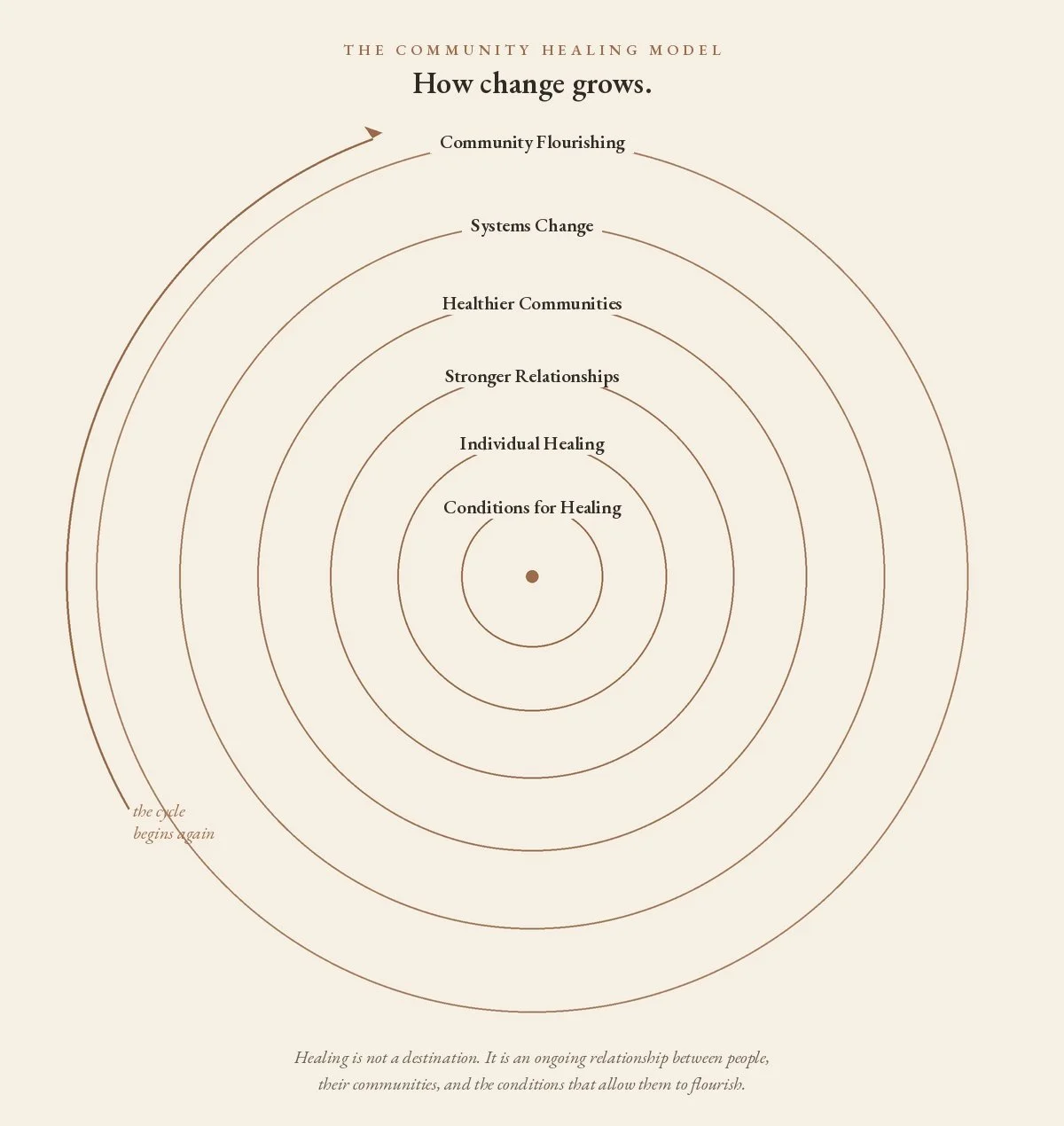
The Community Healing Model shows how that practice creates lasting change — not as a series of isolated outcomes, but as a living system.
It moves from creating the conditions that support healing, through individual healing and stronger relationships, toward healthier communities, systems change, and ultimately community flourishing. Healthier individuals strengthen relationships. Stronger relationships strengthen communities. Flourishing communities create even stronger conditions for the next generation — and the cycle begins again.
Healing, in other words, is not a destination. It is a lifelong relationship between people, their communities, and the conditions that allow them to flourish.
Three ways of working, one purpose: to make healing real, and available to all.
Explore our Philosophy of Healing, or see it in action across our programs.
Healing is a right, not a privilege