
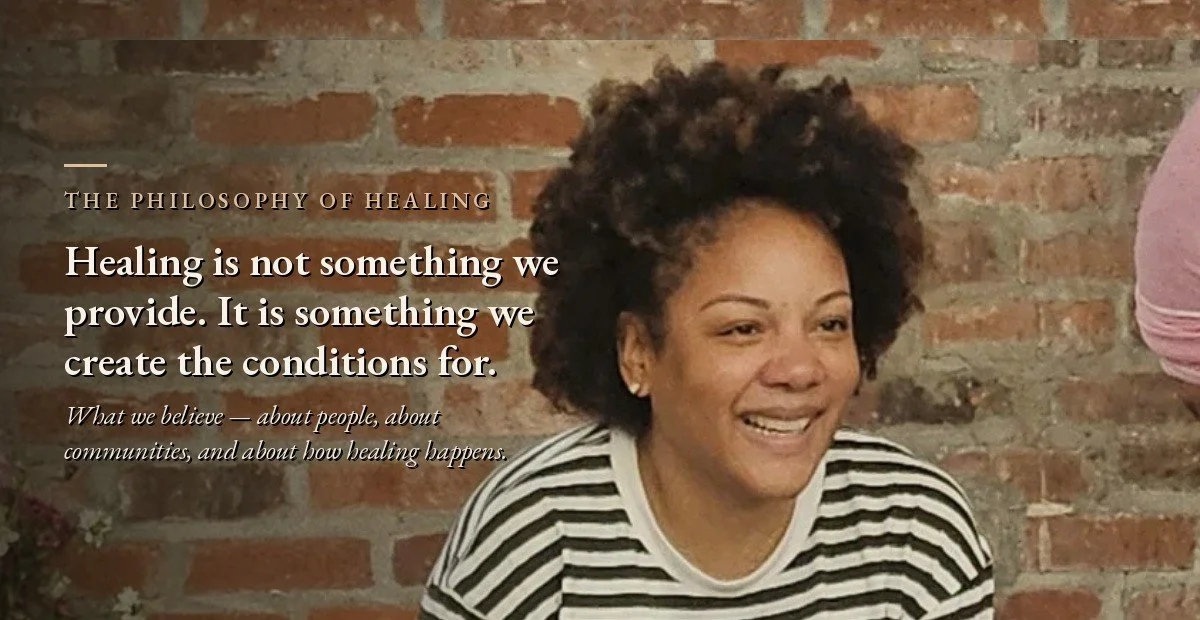
Healing Begins with Belonging
Before people can heal, they need to feel safe.
Before they can feel safe, they need to feel seen.
Before they can feel seen, they need to know they belong.
So belonging isn't a nice-to-have at MCW. It's a health intervention — something we build on purpose. It shapes where we hold programs, who teaches them, how we welcome people, and the partnerships we form.
Belonging is not something we hope participants experience. It is something we intentionally create.
And when people feel it, something shifts. Breathing eases. Bodies soften. Trust grows. Healing begins.
The Body Carries What Words Cannot
Long before an experience can be put into words, the body has already spoken it.
Stress changes how we breathe. Fear changes how we move. Grief settles into the muscles. Caregiving becomes tension we stop noticing. Trauma can teach the body to question safety rather than trust it.
Many people arrive in our programs believing something is wrong with them — anxious, overwhelmed, unable to rest. What they're carrying isn't a flaw. It's a body that has been holding too much for too long.
Our work begins there: with movement, breath, and stillness that let the body set down what words never could.
Listening Is the Work
We don't arrive in a community with a finished program and a plan. We arrive with questions.
Research reveals patterns. Clinicians bring medical expertise. Educators understand how children learn. Community organizations know their own history. Participants carry the wisdom of their own lives. None of these is sufficient on its own.
Listening changes more than what we design. It changes relationships. It shifts power — toward the people who have always understood their communities best.
Our role is not to arrive with all the answers. Our role is to ask better questions.
Representation Is Part of the Medicine
When someone walks into a wellness space, they're often asking silent questions. Will I belong here? Will anyone understand my experience? Will I have to explain who I am before I can begin?
Seeing yourself in the person leading the room answers those questions before they're spoken. It lowers fear. It builds trust. That's why we invest not only in programs, but in people — cultivating wellness leaders from within the communities we serve.
Representation isn't a number we count. It's a relationship we build — one that asks us to keep noticing whose wisdom is honored, and who still feels unseen.
Representation is not separate from the medicine. For many people, it is part of what makes the medicine possible.
Community Is Part of Healthcare
Healing doesn't end when someone leaves a clinic. It continues in the places where people actually live their lives — homes, schools, community centers, neighborhoods.
Healthcare is essential. Physicians, nurses, midwives, and therapists carry people through their hardest moments. But health is built between those moments too — by parents, elders, neighbors, and young people who help us see the world that's emerging.
When care lives in community, health becomes more than treatment. It becomes relationship.
Healing Happens in Relationship
No one heals alone.
We heal in the presence of people who stay — who show up consistently, who hold space without judgment, who remember us week to week. Healing grows in the steady soil of relationship: trust built slowly, safety proven over time, connection that doesn't have to be re-earned each visit.
This is why our work is never a single class or a one-time visit. It's a relationship — with participants, with partners, with communities — sustained long enough for trust to take root and healing to follow.
Access Is Not a Luxury
We believe wellness belongs to everyone — not a luxury reserved for those who can afford it, but a basic human right.
This doesn't mean everyone will heal. It means everyone deserves access to the conditions that make healing possible: safety, dignity, connection, and care that meets them where they are.
That belief is why our programs are free. Why we go into communities rather than waiting for them to come to us. Why no one is turned away.
Healing is a right, not a privilege.