
Where This Began
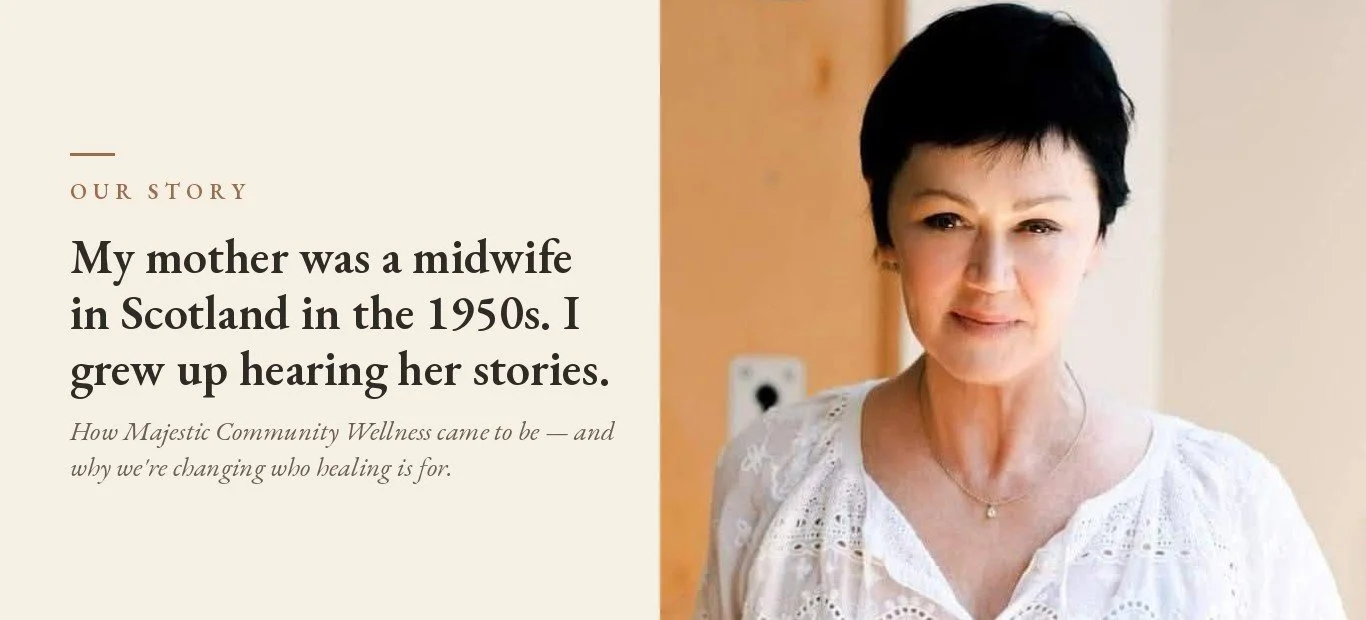
For generations, her family had worked in the coal mines. My grandparents were among the first to build a different life; after leaving the mines, they opened a small ladies' dress shop in Edinburgh. Even then, education was a luxury — my mother's older sister left school at fourteen to help support the family. My mother chose a different path. She became a midwife, and spent decades caring for women through the most vulnerable moments of their lives.
Some of the stories she brought home never left me. Young women who came in to give birth not knowing they'd been pregnant. Unmarried mothers who, at that time and in that place, were not allowed to keep their babies — the law and the church took the children away, and the mothers were left with a grief they were never permitted to speak of again.
My mother carried their heartbreak home with her. It became part of how I saw the world.
Learning What I Couldn't Unsee
My parents were deeply community-oriented. There were always strangers at our table — people who might otherwise have eaten alone.
One of my teachers believed what they did: that it wasn't enough to read about how other people lived — you had to experience it. For several years, once a month, she took us into Roxbury. We spent the day with pen pals in Black neighborhoods and their schools; then they'd come spend a day with us, and we wrote to each other all month long. As a young white girl, that's where I first understood my own privilege — not as an idea, but as something I could feel. It never left me.
Years later, before MCW existed, I was leading teacher trainings with doulas, midwives, and nurses in the room. They spoke about the suffering Black and Brown women endure in the medical system — the dismissals, the pain unheard, the outcomes that should never be. Everything my mother taught me, everything I'd felt as a girl, and everything these women were naming converged into one truth.
What I Came to Understand
I spent thirty years learning who wellness leaves out.
The wellness industry, as it exists today, is not built for everyone. In many Black and Brown communities, healing spaces are scarce — concentrated in affluent neighborhoods that are financially, physically, or culturally out of reach. Even when the doors are open, those spaces can feel like they were built for someone else.
Those barriers aren't accidental. They sit on top of deeper inequities: higher rates of chronic illness, less access to care, and the daily weight of structural racism. Movement, mindfulness, and breath can be powerful medicine — but only when they're within reach.
Representation Is Part of the Medicine
When someone walks into a wellness space, they're often asking silent questions. Will I belong here? Will anyone understand my experience? Will I have to explain who I am before I can begin?
Seeing yourself in the person leading the room answers those questions before they're spoken. It lowers fear. It builds trust. That's why we invest not only in programs, but in people — cultivating wellness leaders from within the communities we serve.
Representation isn't a number we count. It's a relationship we build — one that asks us to keep noticing whose wisdom is honored, and who still feels unseen.
Representation is not separate from the medicine. For many people, it is part of what makes the medicine possible.
Community Is Part of Healthcare
Healing doesn't end when someone leaves a clinic. It continues in the places where people actually live their lives — homes, schools, community centers, neighborhoods.
Healthcare is essential. Physicians, nurses, midwives, and therapists carry people through their hardest moments. But health is built between those moments too — by parents, elders, neighbors, and young people who help us see the world that's emerging.
When care lives in community, health becomes more than treatment. It becomes relationship.
Healing Happens in Relationship
No one heals alone.
We heal in the presence of people who stay — who show up consistently, who hold space without judgment, who remember us week to week. Healing grows in the steady soil of relationship: trust built slowly, safety proven over time, connection that doesn't have to be re-earned each visit.
This is why our work is never a single class or a one-time visit. It's a relationship — with participants, with partners, with communities — sustained long enough for trust to take root and healing to follow.
Access Is Not a Luxury
We believe wellness belongs to everyone — not a luxury reserved for those who can afford it, but a basic human right.
This doesn't mean everyone will heal. It means everyone deserves access to the conditions that make healing possible: safety, dignity, connection, and care that meets them where they are.
That belief is why our programs are free. Why we go into communities rather than waiting for them to come to us. Why no one is turned away.
Healing is a right, not a privilege.